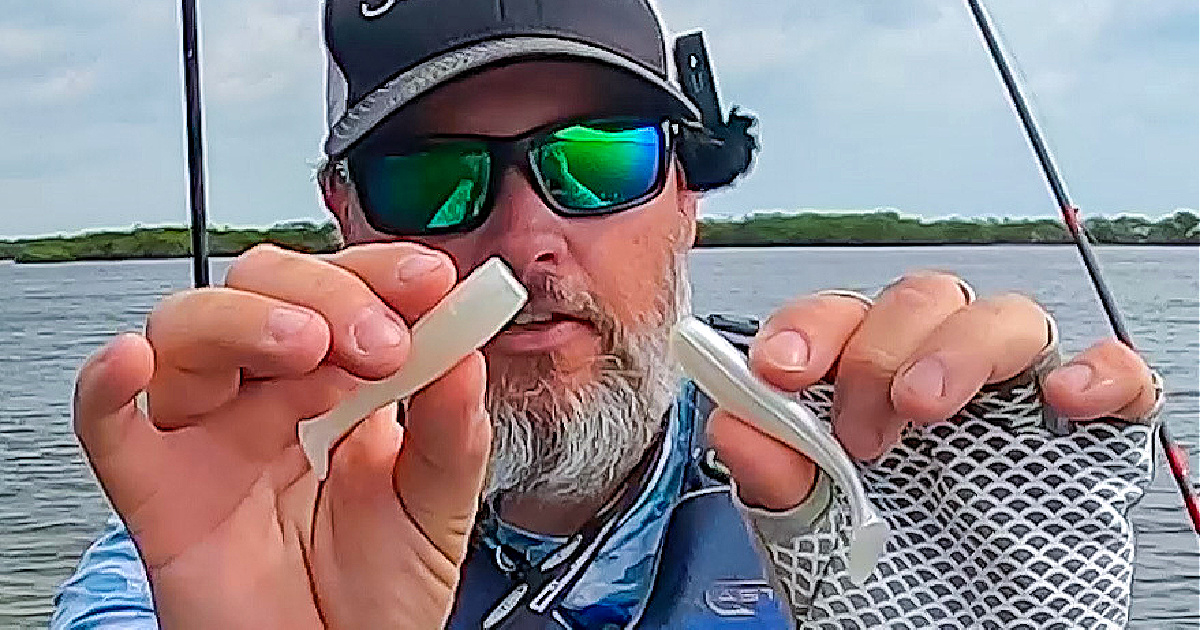
For the last few weeks, I’ve been experimenting with two lure brands: NLBN vs DOA.
The No Live Bait Needed (NLBN) and the DOA C.A.L. Shad Tail to be specific.
The NLBN is the new kid on the block that has quite a social media presence and following, and the DOA has been a staple in inshore fishing for decades.
What gets more bites???
NLBN vs DOA [VIDEO]

Not a member? Then click here to join the Insider Club today so you can get access to Smart Fishing Spots, discounts on the tackle in our shop, and much more all BEFORE prices go up on June 1st!
 See the FULL Insider Report
Set Up For The NLBN:
- Rod: 13 Fishing META 7’2′ MH
- Reel: Daiwa Tatula SV TW
- Line: Daiwa J-Braid x8 Grand 15lb
- Leader: Ande 20lb Mono
- Hook: Hook NLBN 1/8 oz Jig Head
- Lure: NLBN 3-inch Paddle Tail
- Scent: Dr Juice Saltwater Slam Scent
Set Up For The DOA:
- Rod: Cajun Revenant Elite 7’2″ MF
- Reel: Kastking Mega Jaws Elite
- Line: Daiwa J-Braid x8 Grand 15lb
- Leader: Ande 20lb Mono
- Hook: DOA 1/8 oz Jig Head
- Lure: DOA 3 Inch CAL Shad
- Scent: Dr Juice Saltwater Slam Scent
The cost difference between the two is rather large and I wanted to find out if the extra cost for the NLBN lures was worth it.
The comparison was done much the same way as we always do, using the same line and leader to keep the playing field even, casting a set number of times for each one before changing out.
I was using the jigheads made by each brand designed for their lures in 1/8 oz and made five casts with one and five casts with the other alternating the two lures.
Lure Details
The No Live Bait Needed lure is what’s called a hand-pour lure.
It’s made of a soft plastic that creates a ton of action.
DOA is a traditional plastisol material.
With NLBN lures, the action kicks in at a slower speed.
The downside to these lures is they will get chewed up by pinfish and pufferfish because of the light material.
DOA is a bit stronger and more durable.
But, it won’t have as much action as the NLBN lure.
Castability
Because of its bulk and size, the NLBN lure casts a bit further than the DOA.
It’s one of the better 3-inch paddletails for casting out there.
The DOA paddletail is a smaller profile that doesn’t cast all too well.
Rigging
With the DOA paddletail, you can use just about any style of rigging hook from weedless to open jigheads.
Unfortunately, the design of the NLBN paddletail restricts what you can rig it on.
It is specifically designed for their brand of jigheads.
Cost
Typically, soft plastic lures are relatively inexpensive.
But, the NLBN lures are quite expensive.
The difference between my two orders was considerable.
NLBN was nearly twice the amount for less lures.
Final Results
Overall, these two lures caught about the same amount of fish.
Both caught really nice fish and consistently kept up with each other.
FINDING THE FISH HELP
In order to help make sure that you are targeting the right areas based on the latest feeding trends and upcoming weather forecasts, make sure to use the following 3 resources because they will save you a ton of time.
1. WEEKEND GAME PLANS (UPDATED WEEKLY)
These regional game plans will show you exactly what types of spots to target in under 10 minutes… just click the video to start, and you’ll be informed on what to do on your next trip.
2. SMART FISHING SPOTS PLATFORM (UPDATED EVERY 15 MINUTES)
This exclusive software literally shows you where the most fish are likely to be feeding based on exactly when you’ll be fishing. It factors in the tides, wind, and weather to help you quickly see which areas to target throughout the day.
3. COMMUNITY REPORTS (LIVE FEED)
The Insider Community platform is what you can use to see what is biting near you, and you can get to know other members who fish in your area. Plus, you can use it to keep a log of your catches so you can use past trips to help predict future catches.
90/10 ZONE INSHORE FISHING NEWSLETTER
Oh, and be sure to sign up for FREE Access to Salt Strong’s 90/10 Zone Newsletter!
It’s the Ultimate Inshore Fishing Blast with the MOST RECENT on-the-water updates, weekly trends, hot lures, catches of the week, fish tales, conservation news, and everything else for Inshore Fishing…
Sent to your inbox FREE once per week!


I enjoy different products being compered the way you did thanks 👍🌴😎🇺🇸
Excellent presentation Pat. Thanks for the great information.
After field-testing artificial lures for over 50 years, I have found that all lures don’t have the same action, but more importantly, when given the proper action for each specific lure, as it’s designed, you will find out what makes a specific lure most effective. As a disclaimer, I have been on the DOA Pro Staff just about since the company started. I was invited to join them, but I did not seek them out. I was buying their products a couple of years prior to meeting Mark Nichols, and I had some extremely good success with his lures.and that is the reason I use them today. In my opinion, the CAL Shad elicits more strikes when the lure is sharply twitched. I’m not talking about a sweep of the rod, which can be effective at times, but a short, sharp twitch. Prior to using the CAL Shad, I was using the Love’s Lures Swimming Minnow that no longer is made. There really weren’t any other shad style bodies on the market here at the time. I specifically asked Steve and Bill Love to increase the durometer reading on the plastic of that lure so that when I let the lure fall the tail will wiggle minimally. Crippled baitfish do NOT wiggle their tails when they are wounded and in the process of dying. This specific action or lack of action other than a natural fall is one of the things that trigger strikes from predators. Predators seek out weak or wounded baits to eat, and the largest of the species even prefer feeding on dead bait on the bottom. So, IMHO a super soft lure that has a lot of action may not prove to be the most effective. I would bet the NLBN would fare best in the winter when the slowest action is necessary. That might be a better time for testing this lure. But when you end up getting the tails bit off twice as often, not only do you pay more money but you also spend less time fishing and more time changing baits. No doubt, the NLBN can catch fish, but I’ve caught fish on a clothespin before, so fish aren’t that intelligent but they rely on their natural instincts, and the entire effort of using artificial lures is to mimic the real thing, and a dying minnow doesn’t kick its tail while falling.
Great stuff Pat! Thanks, very informative!
Always helpful to me 🙏 thank you Pat
An excellent review, Pat! Your thoroughness is much appreciated and I did not detect bias to slant the outcome one way or the other. I pay little attention to all the marketing hype and giddiness of the cult like sheep each time a new lure is introduced. One other point about the NLBN not being very durable, and that’s the wasted time having to change the bait more frequently that results in lost fishing time. You’ve said less time should be spent on fussing over lures and their colors. Instead, choose a confidence bait that works based on that angler’s experience, and focus on finding the fish. That message is solid and worthy of being repeated, especially to newer Insiders when the marketing hype ramps up each time a new lure or color is launched. 👏👍
Thanks Rob!
That’s a great point about having to change out the lure creating lost time on the water.
I wanted this to come out as non biased and that’s why I didn’t want to compare these against our any of our lures, it would be difficult to come across not having favoritism in the casual viewers eyes.
I also did not want this to come out as a negative or bashing either one, I appreciate what they are trying to do and both companies offer unique solutions for situations that no other company does. In fact I want to try NLBN’s Mini Mullets, they look great for skipping under docks and mangroves.
I’ll keep championing the notion of finding feeding fish is way more important than finding the magic lure or color, it’s hard to fight that great American marketing machine.
Thanks for the feedback and I’ll let you know how I like the other lures!
Your insight is always very good, Pat. Your comment “I’ll keep championing the notion of finding feeding fish is way more important than finding the magic lure or color” is spot on. Keep up these great presentations.
Thanks for the report Pat. I started using the DOA CAL Shads several years ago while searching for an effective paddletail that’s also a good value. The DOA CAL Shads are both. You get 12 baits for around $5 and I’ve caught many many fish with them including multiple 30” redfish and my PB 14 snook in one day. I disagree with your assessment of their cast ability. They are more dense than the average 3” paddletail and cast quite a good distance when rigged on a 1/8 or 3/16 jighead. For these reasons they were my go to paddletails until Salt Strong developed the 2.0 and Mulligan which are my current go to paddletails. The reason I switched is the main negative you stated. You must fish them at a faster pace or apply sharper twitches to get the tail working which makes them less effective when trying to fish slowly. And once I saw the 2.0 swim on the fall I was sold. Great content and discussion Pat.
Great feedback Nick!
It could possibly be that I felt the DOA did not cast as well because the NLBN did and it made the DOA look bad in that regard. I should do a casting contest where I measure what the actual distance is, that would be fair. But between those two, personally I would go with DOA all day.
Great video. Is there a reason why you didn’t use the 2.0 (or even the Mulligan) instead of the DOA? The tail may kick sooner with the 2.0. The 2.0 would still would have the same rigging options as the DOA. The 2.0 may have been harder to cast into the wind than the DOA. Just curious.
Great question Mark!
The reason I did not use the 2.0 for this is because I wanted to do a unbiased review of these two lures. If I compared either against the 2.0 individually, it would be difficult for the casual viewer to believe I didn’t lean in a certain way. I chose these two lures because they are popular and have a following of their own.
Both of these lures caught fish but I would choose the 2.0 over either of these. It’s the balance of cost, action and ability to be rigged in different ways that makes the 2.0 shine in my opinion.
Appreciate you watching and asking the question!